
Delivery notes in restaurants: checks and retention
Delivery notes in restaurants: how to check them at goods receiving and retain them correctly in Germany, Austria and Switzerland.
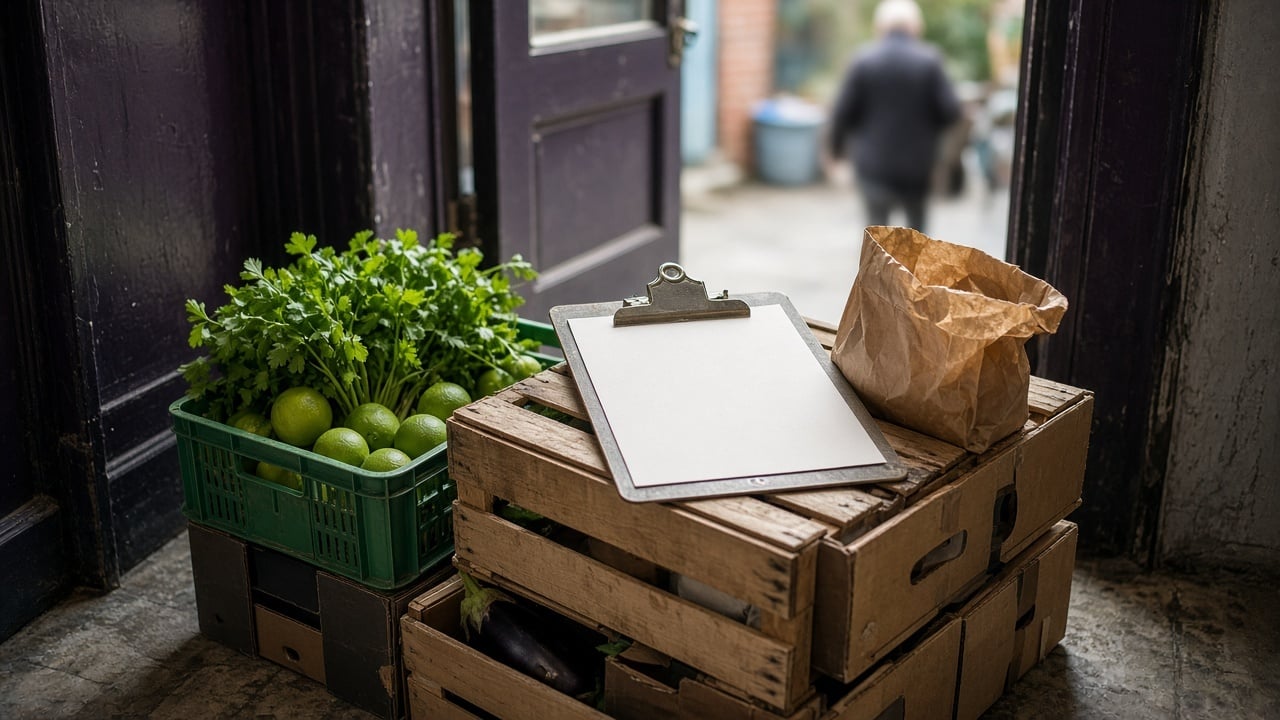
Delivery notes in restaurants: checks and retention
A delivery note in a restaurant accompanies a delivery from suppliers to the kitchen, bar or storeroom and lists what actually arrived. In Germany there is no general legal requirement to issue one or for its content. How long it must be retained depends on its function: a pure delivery document, an accounting document (Buchungsbeleg), or an invoice. This article covers checking, acceptance and retention for Germany, Austria and Switzerland.
Key facts at a glance
- In Germany, per IHK Südthüringen, there is no legal requirement to issue a delivery note or for its content.
- If a delivery note is used for billing and contains the required details under section 14 of the German VAT Act (UStG), it can count as an invoice.
- Since 1 January 2025, the e-invoice (E-Rechnung) has changed the delivery note’s role as proof for invoicing.
- An 8-step acceptance checklist helps check a delivery note at goods receiving (Wareneingang).
- If the delivery does not match the delivery note, section 363 BGB (German Civil Code) governs the burden of proof on acceptance, and the relevant national duty to give notice of defects (Rügepflicht) applies.
- For pure delivery notes, Germany’s tax retention period generally ends on receipt of the invoice; as an accounting document or invoice it is 8 years, with other obligations and extensions still possible. Austria applies a standard 7-year period, Switzerland 10 years for accounting documents.
- Digital delivery notes in DESADV format transfer the delivery note number and changed quantities and prices into the restaurant’s order.
What is a delivery note, and what isn’t it?
A delivery note is a document that accompanies a delivery of goods and lists what was delivered; only the general minimum requirements for business letters (Geschäftsbrief) apply, so a delivery is possible without one. Delivery notes vary between suppliers, from a bare list of items to documents that also include prices or a signature field. Nor does one replace a quality check: its evidential value depends on its content, signature and any reservations noted, while freshness and matching the order are checked separately at goods receiving.
When does a delivery note become an invoice?
A delivery note remains a delivery note as long as it does not go beyond listing the goods. If used for billing, the required details follow the relevant invoicing rules; if an invoice refers to it, it can instead become part of a multi-document other invoice (sonstige Rechnung), which changes how long it must be retained.
The delivery note contains all the required invoice details
If a single delivery note is used for billing and contains the mandatory details under section 14(4) UStG, it can be an invoice regardless of what it is called, since under section 14(1) sentence 1 UStG an invoice is any document used to bill for a delivery. The amount, tax rate and sequential number alone are not enough.
A special rule applies for small amounts. In Germany, the small-value invoice (Kleinbetragsrechnung) threshold under section 33 of the German VAT Implementing Ordinance (UStDV) is 250 euros; reduced mandatory details then suffice, and the document can be issued on paper or, with the recipient’s consent, as a PDF. Billing via the delivery note qualifies the same way, up to that amount. In Austria, the comparable threshold is 400 euros gross per the Austrian Federal Economic Chamber (WKO) FAQ.
The invoice refers to the delivery note
More often, an invoice refers to the associated delivery note: for other invoices (sonstige Rechnung), a clearly identified delivery note can supply missing details, though additional requirements apply to the date of supply. Under section 31(1) UStDV, an invoice can consist of several documents if the one stating the amount and tax also names the others, such as the delivery note. It then becomes part of a multi-document other invoice without itself being complete, and per IHK Südthüringen the invoice’s retention period continues to apply.
What the e-invoice changes for delivery notes
Since 1 January 2025, transactions between domestic businesses have generally required a structured e-invoice (E-Rechnung) under section 14(2) sentence 2 no. 1 UStG, with EN 16931-compliant and certain interoperable formats permitted; businesses must be able to receive these, per the BMF letter of 15 October 2025, German VAT Application Decree (UStAE) 14.1(5) sentence 1.
The transitional period for paper and other electronic formats runs until 31 December 2026 under section 27(38) UStG, with consent needed for PDF and other transitional formats. For 2027 transactions, this extends to 31 December 2027 if the issuer’s prior-year turnover was no more than 800,000 euros; non-conforming EDI invoices are likewise permitted until year-end 2027.
Only for other invoices (paper or PDF), per the BMF, may the delivery note be referred to for the description of the supply (UStAE 14.5(1) sentence 19); under section 31(1) UStDV only an other invoice can consist of several documents, and in an e-invoice the date of supply must appear in the structured data format (UStAE 14.5(16) sentences 4 to 6), though supplementary details may appear in an attachment (UStAE 14.5(15) sentence 3). The BMF cites checking the invoice against the order, delivery note or proof of payment as an internal audit trail example (UStAE 14.4(6) sentence 2), so the delivery note remains an important control document.
What details should be on a delivery note?
Because there is no legal requirement in Germany for the content of a delivery note, businesses can take their bearings from chamber of commerce recommendations.
| Recommended detail (IHK) | What it helps with at goods receiving |
|---|---|
| Name and address of the seller / supplier | Clear identification of the delivery |
| Name and address of the recipient | Assignment to your own business |
| Date of issue | Comparison with order date and delivery date |
| Specific description of the type and quantity of goods | Quick check against the order |
| Order and/or delivery number | Automatable matching with the order |
| Order, dispatch and delivery date | Traceability of the delivery route |
| Partial deliveries, if any | Visibility of open remaining quantities |
| Signature field for receipt | Proof of acceptance of goods |
A minimum standard agreed with key suppliers eases the daily check.
Acceptance checklist: checking a delivery note in 8 steps
A structured acceptance process determines whether a delivery note serves as reliable proof for goods receiving. The following 8-step checklist is our own practical recommendation, with no legal requirement behind it.
-
Have the order ready: from purchasing and the ordering process, to compare quantities and items directly.
-
Check the supplier and delivery note number: against the expected delivery.
-
Count or weigh each item: against the delivery note, not just glance at it.
-
Visually check condition, temperature and shelf life: packaging, the cold chain and best-before dates, as part of internal controls.
-
Mark substitute items and partial deliveries: directly on the delivery note.
-
Note empties and deposits (Leergut und Pfand): type and number of returned containers, on the delivery note.
-
Record discrepancies and have them countersigned: in writing, by the driver where possible.
-
Only then sign and record digitally: with date, time and block-letter name, then record it digitally right away.
Who signs is an internal matter; we recommend a fixed responsibility per shift and a legible name in block letters.
What to do if the delivery does not match the delivery note?
If a delivery does not match the delivery note, a business has two levers: acceptance under reservation and the notice of defects. The reservation and the notice of defects serve different functions; a specific notice of defects can already be given at the time of delivery.
Acceptance under reservation and the burden of proof
Anyone who accepts a performance as fulfilment bears the burden of proof under section 363 BGB if they later complain it was incomplete or incorrect. A signed delivery note counts, per IHK Südthüringen, as strong evidence the goods were taken over in correct condition and quantity, regardless of whether the signature is digital or handwritten. Anyone with doubts can accept under reservation; this is a documentation recommendation without guaranteed legal effect, with effect depending on its content and circumstances.
Notice of defects for perishable goods in Germany, Austria and Switzerland
The duty to give notice of defects differs between the three countries. In Germany, where the purchase is a commercial transaction for both parties, the goods must be inspected and any defect reported without delay under section 377 of the German Commercial Code (HGB); timely dispatch of the notice suffices, with no fixed number of hours set, and whether a transaction counts as commercial must be assessed case by case.
In Austria, under section 377 of the Austrian Commercial Code (UGB), where the purchase is business-related for both parties, a reasonable period applies for giving notice; otherwise warranty rights, damages for the defect itself, and the right to rescind for error about the absence of defects are lost.
In Switzerland, under Art. 201 of the Swiss Code of Obligations (OR), the goods should be inspected as soon as the usual course of business allows, with immediate notice given if there are defects; the rule does not require a purchase between merchants, and special time limits apply for certain construction defects. We recommend checking perishable goods promptly and citing the delivery note number in writing.
Partial, summary and subsequent deliveries, and empties
Not every delivery arrives complete; for partial deliveries (Teillieferung), summary invoices (Sammelrechnung), subsequent deliveries (Nachlieferung) and empties, we recommend clear labelling on the delivery note so goods receiving stays traceable.
A partial delivery should be marked on the delivery note so the open remaining quantity stays visible. Under section 31(4) UStDV, the calendar month can also serve as the date of supply for other invoices, making summary invoices over a period practicable. We recommend giving a subsequent delivery its own delivery note, referencing the original.
For empties and deposits (Pfand), note the number and type of items returned on the delivery note, countersigned by the driver, so a later deposit credit can be matched against the invoice without losing track of individual containers.
How does the three-way match of order, delivery note and invoice work?
The three-way match, our own checking model, compares the order, the delivery note and the invoice to uncover discrepancies before a payment is released.
| Match | What is checked | Typical error |
|---|---|---|
| Order against delivery note | Quantity and items in the delivery | Substitute item without a note |
| Delivery note against invoice | Quantity and price per item | Deviating quantity entry |
| Invoice against catalogue price | Agreed or listed price | Outdated or incorrect price |
The three-way match links to goods receiving, cost of goods sold, stocktaking and shrinkage: per the calculating cost of goods sold guide, actual consumption is opening stock plus goods receiving minus closing stock, so an incomplete match can make stocktaking in restaurants and shrinkage control more difficult.
Traceability: why the delivery note also matters for food safety
A delivery note in a restaurant supports commercial checking and food traceability. Under Art. 18 of Regulation (EC) 178/2002, food business operators must be able to identify any person from whom they received a food, with systems to pass it to authorities on request. A delivery note is a practical, though not required, way to record this; we recommend filing the supplier, delivery date and batch information for quick retrieval, ideally digitally.
How long must a delivery note be retained in Germany?
How long a delivery note must be retained in Germany depends on its function.
Delivery note without an accounting-document function
A delivery note normally accompanies the goods, with the invoice following. Under section 147(3) sentences 3 and 4 of the German Fiscal Code (AO), its retention period ends on receipt of the associated invoice, or, if sent out, on dispatch of the invoice. This has applied, per Art. 97 section 19a(1) sentence 2 EGAO, since 1 January 2017, introduced, per IHK Südthüringen, by the Second Bureaucracy Relief Act (Zweites Bürokratieentlastungsgesetz); suspensions of expiry (Ablaufhemmung) and other retention obligations must be checked separately.
Delivery note as an accounting document or invoice: 8 years
If it is itself an accounting document or used for billing as an invoice, a longer period applies: 8 years for accounting documents under section 147(3) sentence 1 AO, and likewise for invoices under section 14b(1) UStG. This has applied since 1 January 2025, for accounting documents under Art. 97 section 19a(2) EGAO whose period had not yet expired on 31 December 2024, and for invoices under section 27(40) UStG; previously, 10 years applied.
Start of the period, suspension of expiry and commercial law
For accounting documents, the period begins under section 147(4) AO at the end of the creation year; for invoices, under section 14b(1) UStG sentence 3, at the end of the year of issue, even if received later. Nor does it expire under section 147(3) sentence 5 AO while relevant to taxes whose assessment period (Festsetzungsfrist) is still running.
Under section 257 HGB, accounting documents are retained for 8 years and received commercial letters (Handelsbrief) for 6 years, though this contains no special rule for delivery notes comparable to section 147(3) sentences 3 and 4 AO. Whether a delivery note counts as a commercial letter is unclear; we recommend keeping it until any invoice or complaint is resolved.
How long does retention apply in Austria and Switzerland?
Which retention period applies to a delivery note in Austria depends on its function within the business. Books, records and associated documents must be retained for 7 years under section 132(1) BAO; the period begins at the end of the calendar year to which the document relates, or, where the financial year differs, at the end of that calendar year, and it runs longer while relevant to pending tax proceedings.
Per the WKO FAQ on the e-invoice, delivery notes count as such documents under the BAO. The Austrian Supreme Administrative Court (VwGH) ruled on 11 December 2003 that retaining delivery notes is not replaced by retaining invoices, and for business letters and accounting documents the period under section 212 UGB is likewise 7 years.
In Switzerland, the period for business books, accounting documents, and the annual and audit reports under Art. 958f of the Swiss Code of Obligations (OR) is 10 years from the end of the financial year. Business books and accounting documents may be retained electronically under these conditions if they correspond to the business transactions and the data remains readable at all times; special formal requirements apply to the reports.
The following table compares the retention periods for delivery notes in the three countries.
| Country | Legal basis | Period for delivery notes | Start / end of period | Selected requirements (see text for details) |
|---|---|---|---|---|
| Germany (not an accounting document) | Section 147(3) sentences 3 and 4 AO | Received: until receipt of the invoice; sent: until dispatch of the invoice | End of period: receipt or dispatch of the invoice | Availability, readability, capability for machine evaluation |
| Germany (accounting document/invoice) | Section 147(3) sentence 1 AO, section 14b UStG | 8 years | End of the year of creation or issue | Availability, readability, capability for machine evaluation |
| Austria | Section 132(1) BAO | 7 years (standard period) | End of the year to which it relates; where the financial year differs, end of the calendar year in which it ends | Complete, orderly, identical in content, faithful to the original (urschriftgetreu) |
| Switzerland | Art. 958f OR | 10 years as an accounting document | End of the financial year | Corresponding to the business transaction, readable at all times |
Archiving delivery notes digitally: GoBD, BAO and GeBüV
A suitable digital archive keeps a delivery note findable; Germany, Austria and Switzerland each set their own technical requirements. In Germany, section 147(2) AO permits reproduction on image or data media if it corresponds visually to the original, remains available throughout the period, and stays immediately readable and machine-evaluable.
Under the German principles for the proper keeping and retention of books, records and documents in electronic form (GoBD), BMF letter of 28 November 2019, paragraph 136, the image-capture procedure must be documented, ideally via an organisational instruction on who captures which documents, when, and how quality control and error logging work. Per paragraph 140, paper documents may then be destroyed unless another provision requires the original; per paragraph 139, further processing must use the electronic document, and any reprocessed paper must be captured again and linked to the first version.
In Austria, retention on data media is permitted under section 132(2) BAO if a complete, orderly reproduction identical in content and faithful to the original (urschriftgetreu) is guaranteed until the end of the period; per the WKO, scanning onto a USB stick alone is not enough; what is needed is, for example, unalterable WORM storage. In Switzerland, Art. 9 of the Swiss Ordinance on the Maintenance and Retention of Accounts (GeBüV) expressly permits unalterable data media.
As our own recommendation, a simple process works day to day: a photo on acceptance, unalterable storage, and the delivery note number as a search field, alongside the procedural documentation (Verfahrensdokumentation) and retention periods above.
Digital delivery notes via DESADV
Some suppliers now send delivery notes digitally in DESADV format, not only on paper.
According to the Help Center on automatic delivery note matching, FoodNotify then takes over the delivery note number, quantity and price changes, and substitute products. Suppliers can send a digital delivery note before the goods have actually arrived. The format is explained in the Help Center on digital delivery notes.
What hotels, bars and groups need to consider in addition
With multiple locations, central auditability matters: inconsistent filing makes matching against central orders time-consuming. FoodNotify’s inventory management and centralized inventory management for restaurant chains help match orders, delivery notes and invoices.
Frequently asked questions about delivery notes
Is a delivery note mandatory?
No, in Germany there is, according to IHK Südthüringen, generally no legal requirement to issue one. The delivery of goods itself is unaffected by this and takes place even without this document. A delivery note in a restaurant makes checking at goods receiving easier.
What must be on a delivery note?
There are no statutory mandatory details in Germany. IHK Südthüringen recommends, among other things, name, address, date of issue, description of the goods, and an order or delivery number. Businesses can additionally add prices and a signature field.
How long do I have to retain delivery notes?
That depends on the country and on the function. In Germany, the period for pure delivery notes generally ends on receipt of the invoice; for accounting documents and invoices, 8 years apply. In Austria, the standard period is 7 years; in Switzerland, 10 years for accounting documents.
What is the difference between a delivery note and an invoice?
A delivery note accompanies the delivery of goods without any statutory form requirement. An invoice, by contrast, serves to bill for the goods and must contain the prescribed invoice details. The two documents coincide when billing is done with the delivery note and it contains these details.
Do I have to sign the delivery note?
No, according to IHK Südthüringen the signature field is an optional recommendation; it does not create any guarantee of quality. Whether the signature is digital or handwritten is, according to the IHK, irrelevant.
What do I do if the delivery does not match the delivery note?
Discrepancies should be noted directly on the delivery note, and acceptance should be made under reservation if there is any doubt. For perishable goods, the relevant national duty to give notice of defects also applies.
What happens if I accept defective goods?
Without a timely notice of defects, the goods are deemed approved under section 377 HGB where the purchase is a commercial transaction for both parties. Hidden defects must be reported without delay after discovery; in the case of fraudulent concealment, section 377(5) HGB applies. Every discrepancy should already be documented on acceptance.
May I retain delivery notes purely digitally?
Yes, purely digital retention is generally permitted in Germany, Austria and Switzerland. Among other things, correspondence with the original, integrity, availability and readability must be guaranteed in line with the respective national requirements.
May I throw away the paper delivery note after scanning it?
Yes, provided the image capture is carried out properly, GoBD-compliant procedural documentation exists, and no other provision requires the original. Without proper documentation, throwing away the original remains a risk.
Does the e-invoice replace the delivery note?
No, the e-invoice does not replace the delivery note, but it does change its role in invoicing law. As a control document, the delivery note remains important in restaurants.
How do I document empties and deposits on the delivery note?
It is advisable to note the number and type of returned containers directly on the delivery note and have this countersigned. This allows a later deposit credit to be matched against the invoice. This practice is a business recommendation, not a statutory requirement.
May I take over a digital delivery note before the delivery arrives?
No, a digital delivery note should only be taken over once the goods have actually arrived. Suppliers can transmit such delivery notes by the delivery day. The details should therefore be compared with the actual delivery before being taken over.
Conclusion: check delivery notes properly and retain them correctly
A delivery note in a restaurant is generally not a mandatory document in Germany, but it can support goods receiving, invoice checking and traceability. Depending on function and country, standard retention periods run up to ten years, and extensions remain possible. A structured 8-step acceptance checklist, clear reservations for discrepancies, and GoBD or BAO-compliant digital archiving can reduce risk day to day.
This article does not replace tax or legal advice.
FoodNotify supports matching between the digital delivery note and the order in restaurants. Anyone who wants to try this matching process in their own business can book a demo.
Sources
- IHK Südthüringen, The delivery note in business transactions: https://www.suhl.ihk.de/unternehmen/recht/aktuelles/februar-2026/der-lieferschein-im-geschaeftsverkehr
- German Fiscal Code (Abgabenordnung), section 147: https://www.gesetze-im-internet.de/ao_1977/__147.html
- EGAO, Art. 97 section 19a: https://www.gesetze-im-internet.de/aoeg_1977/art_97__19a.html
- German VAT Act (Umsatzsteuergesetz), section 14: https://www.gesetze-im-internet.de/ustg_1980/__14.html
- German VAT Act, section 14b: https://www.gesetze-im-internet.de/ustg_1980/__14b.html
- German VAT Act, section 27: https://www.gesetze-im-internet.de/ustg_1980/__27.html
- German VAT Implementing Ordinance (Umsatzsteuer-Durchführungsverordnung), section 31: https://www.gesetze-im-internet.de/ustdv_1980/__31.html
- German VAT Implementing Ordinance, section 33: https://www.gesetze-im-internet.de/ustdv_1980/__33.html
- BMF letter of 15 October 2025 on the e-invoice (linked in the text) and BMF FAQ on the e-invoice: https://www.bundesfinanzministerium.de/Content/DE/FAQ/e-rechnung.html
- German Civil Code (Bürgerliches Gesetzbuch), section 363: https://www.gesetze-im-internet.de/bgb/__363.html
- German Commercial Code (Handelsgesetzbuch), section 377: https://www.gesetze-im-internet.de/hgb/__377.html
- German Commercial Code, section 257: https://www.gesetze-im-internet.de/hgb/__257.html
- Austrian Commercial Code (Unternehmensgesetzbuch), section 377: https://www.ris.bka.gv.at/NormDokument.wxe?Abfrage=Bundesnormen&Gesetzesnummer=10001702&Paragraf=377
- Austrian Commercial Code, section 212: https://www.ris.bka.gv.at/NormDokument.wxe?Abfrage=Bundesnormen&Gesetzesnummer=10001702&Paragraf=212
- Swiss Code of Obligations (Obligationenrecht), Art. 201 (version of 1 January 2026, linked in the text): https://www.fedlex.admin.ch/eli/cc/27/317_321_377/de
- Austrian Federal Fiscal Code (Bundesabgabenordnung), section 132: https://www.ris.bka.gv.at/NormDokument.wxe?Abfrage=Bundesnormen&Gesetzesnummer=10003940&Paragraf=132
- WKO, questions and answers on the e-invoice: https://www.wko.at/digitalisierung/fragen-und-antworten-zur-e-rechnung
- WKO, VAT invoice FAQ: https://www.wko.at/steuern/umsatzsteuer-rechnung-faq
- WKO, retention obligations: https://www.wko.at/steuern/aufbewahrungspflichten
- VwGH 11 December 2003, 2000/14/0113: https://www.ris.bka.gv.at/Dokument.wxe?Abfrage=Vwgh&Dokumentnummer=JWR_2000140113_20031211X05
- KMU Portal, electronic retention of business books (Art. 958f OR, GeBüV): https://www.kmu.admin.ch/de/elektronische-aufbewahrung-der-geschaeftsbuecher
- GoBD, BMF letter of 28 November 2019 (paragraphs 136, 139, 140; copy from IHK München, linked in the text) and BMF second amendment letter of 14 July 2025: https://www.bundesfinanzministerium.de/Content/DE/Downloads/BMF_Schreiben/Weitere_Steuerthemen/Abgabenordnung/2025-07-14-GoBD-2-aenderung.pdf?__blob=publicationFile
- Regulation (EC) 178/2002, Art. 18: https://eur-lex.europa.eu/legal-content/DE/TXT/HTML/?uri=CELEX:32002R0178
- Help Center, digital delivery notes and DESADV: https://help.foodnotify.com/digitale-lieferscheine-desadv
- Help Center, automatic delivery note matching: https://help.foodnotify.com/wie-funktioniert-der-automatische-lieferschein-abgleich