Recipe Management in Foodservice: Automating Allergen Labeling
Recipe management without manual overhead: how digital systems automatically derive allergens, nutritional values and CO2 data from supplier data —...
Restaurant sustainability in 2026: cut food waste, lower CO2, source smarter, meet reuse mandates and ESG reporting. With a 12-month roadmap.

Sunday evening, just after eleven. The last guests have left, and the dishwasher tips the second bin of scraps into the blue container. The mental tally keeps running: chicken breast from the mise en place, half a salmon from lunch service, two trays of ratatouille nobody ordered. And at half past six the next morning, the supplier rolls up with crates of tomatoes from Almeria, because once again nobody thought about the regional source when placing the order.
Almost every restaurateur knows this moment. In a concept workshop, sustainable hospitality sounds like a good intention; at the trash compactor, it sounds like lost money. Both are true: what you waste in food, energy, packaging, and procurement channels has a direct impact on your margin, on staff retention, and on what your guests will write about you on Google two years from now.
This guide organizes the key levers into four operational areas, plus ESG reporting as the overarching framework. You'll get a 12-month roadmap, an honest breakdown of what's mandatory versus optional, and links to in-depth FoodNotify articles on each area. We won't promise you quick wins or a flawless greenwashing story. We'll give you a plan you can start implementing Monday morning.
External pressure is becoming more concrete. The EU is calling for significantly less food waste per capita by 2030, the Mehrwegangebotspflicht has been in force since early 2023, and the national transposition of the revised Waste Framework Directive has a clear timeline (European Parliament, 2025). In the hospitality industry, energy costs rose by 27.6 percent between January 2022 and July 2025. Labor costs climbed by 34.4 percent between January 2022 and Q4 2024 (DEHOGA survey on the economic situation, August 2025). Both cost blocks are squeezing hospitality margins at the same time. Anyone who embeds sustainability operationally now protects their margin twice over: once through lower losses, and once by preparing for obligations that are coming anyway.
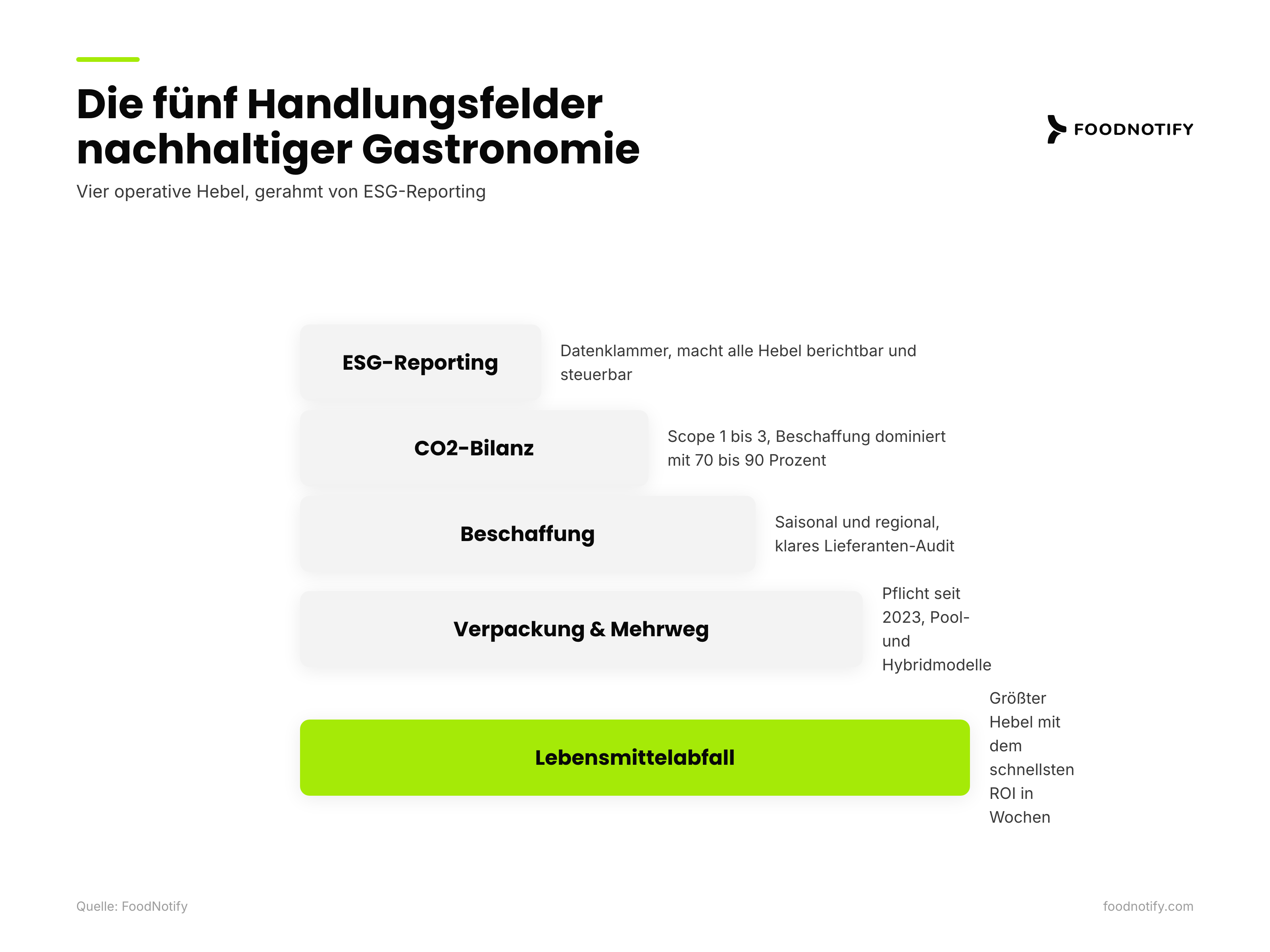
In marketing, sustainable hospitality is often reduced to two words: regional and plastic-free. That's not enough. Anyone who wants to run a sustainable operation needs to understand where resources are actually being lost in their business. Four operational levers determine impact and ROI. A fifth, ESG reporting, holds everything together and makes it verifiable.
ESG reporting acts as the framework holding these four areas together. You're already collecting data on food cost, energy, procurement, and packaging anyway. The difference between scattered spreadsheets and a reliable sustainability metric lies in the structure of your data foundation and in whether you can compare changes across quarters.
Where's the line with greenwashing? Greenwashing is an organic logo on the menu with no supplier documentation behind it. Sustainable hospitality in 2026 means: you know your food cost per dish, how much food waste is generated per guest, what share of your procurement comes from the local area, and whether your reusable packaging rate is growing — tracked over multiple years, not on a marketing slide. That's exactly the task of the chapters that follow.
Modern inventory management systems like FoodNotify solve exactly this data challenge at their core, but not every system captures all four levers equally well. You'll find the requirements your platform should meet further below.
Food waste isn't just an ethical issue. It's the most expensive line item in your food cost ratio that never shows up on an invoice. Most restaurateurs know their food cost down to the cent, but only have a gut estimate of their waste. That's exactly where the potential lies.
Germany produced around 10.8 million tonnes of food waste in 2022 (BMLEH, 2024). Out-of-home catering accounted for 2.0 million tonnes of that, or 18 percent. United Against Waste e.V. documented an avoidance potential of 30 to 50 percent across more than 720 measurements in hotels, corporate catering, schools, hospitals, and chain restaurants (United Against Waste, 2020). Pilot operations already saved a significant share of their waste volume in the first step. The main causes are overproduction during prep and plate waste returned by guests.
Why is food waste the entry point for every sustainability strategy? Three reasons interlock:
Operationally, the rollout works in three steps that build on one another. First, you weigh and measure waste for one week by day and category, that is, prep, plate waste, and buffet surplus. Then you translate the losses into money, which usually produces the same aha moment as a first food cost analysis. Finally, you define two to three concrete measures per loss category and review them monthly.
Example scenario: A bistro chain with three locations measures plate waste on its lunch menus for one week. Result: the pasta portion is on average 40 grams too large, and one in three guests leaves food on the plate. Reducing the standard portion by 30 grams and offering an optional larger portion for a surcharge measurably lowers the food cost per pasta dish over the following four weeks. Small iterations like this are the heart of operational sustainability.
We go deeper into the details, from the specific measurement method to how it feeds into your food cost calculation, in our cluster article Reducing Food Waste in Hospitality. There you'll also find templates for the measurement log and a calculation example you can use to convert your waste into monthly food cost points.
The second lever is your carbon footprint. This gets more complex, because emissions arise in places that don't show up on your electricity bill. Still, the effort pays off: a reliable baseline will become a prerequisite for banks, major clients, and chain partners in the coming years.
Carbon footprints distinguish three areas, known as scopes. Scope 1 covers direct emissions from your own equipment, such as a gas stove, heating, or company vehicle. Scope 2 covers emissions from purchased energy, mainly electricity. Scope 3 is everything else: your procurement, that is, the emissions generated during the growing, processing, transport, and refrigeration of your food. In hospitality, Scope 3, which is dominated by procurement, typically accounts for around 80 to 95 percent of total emissions (Klimato, Food Emissions Reporting Guide, 2024). If you only watch the electricity meter, you're optimizing the smallest line item.
Imagine you run an 80-seat restaurant with a moderate share of meat on the menu. Most emissions are generated before the schnitzel even reaches your kitchen. For beef, it's methane emissions from livestock farming; for cheese, it's energy-intensive aging; for exotic fruit, it's refrigerated transport. If you don't know these figures, you're optimizing blind.
What actually helps? A simple starting point is to record the CO2 value for each dish using publicly available food databases. The KlimaTeller app only awards its label if a dish produces at least 50 percent fewer CO2 equivalents than a comparable standard German meal. On average, that saves around one kilogram of CO2 per plate (KlimaTeller, National Climate Initiative, 2024). When marked on menus, it measurably shifts ordering behavior toward plant-based options.
On the energy side, analyses from the DEHOGA Energy Campaign show that energy costs in hospitality account for up to 10 percent of annual revenue, with heating making up roughly two-thirds of that (DEHOGA Energy Campaign, 2024). Even simple organizational measures, such as switching off the fryer earlier, optimizing walk-in cooler opening times, or adjusting the heating curve, cut energy costs by up to 10 percent. Technical investments, such as modern heat recovery in the dishwasher or converting dining areas to LED, add another saving of roughly the same order of magnitude. Context: energy costs in the hospitality industry have risen 27.6 percent since January 2022 ([DEHOGA, 2025](https://www.dehoga-bundesverband.Every percentage point of reduction is now worth double in cost terms.
For the detailed methodology, from choosing a CO2 calculator to updating your baseline annually, we go deeper in the cluster article Carbon Footprint in the Restaurant: Measuring and Reducing It. There you'll also find a practical selection of freely accessible data sources for DACH-region businesses.

Procurement is the lever everyone feels entitled to weigh in on, yet in practice only a few actually change anything. The reason: seasonality sounds simple in marketing, but it runs up against your existing supplier network, volume requirements, and the fact that your tomato sugo needs the same thing in February that it needed in August.
An honest stock-take hurts. The organic share in Germany's out-of-home catering sector is around 1 percent; the BMLEH is targeting 30 percent as part of its Organic Strategy 2030 (BMLEH Organic Strategy 2030, 2025). There's a gap between aspiration and everyday reality that can only be closed through operational action, not more commitments on the website.
Switching to seasonal, regional procurement follows a clear three-phase process. First, you audit your existing supplier list and sort each wholesaler into a category: regional, national, or international. You'll be surprised how much comes, unnoticed, from Spain, the Netherlands, or Italy. Next, you build a seasonal calendar directly into your recipe management, so standard dishes automatically switch to the seasonally available variant. Finally, you negotiate minimum order quantities and delivery schedules with two to three regional sources per product category, so you don't get caught in a shortage.
Realistic shares matter. For fresh produce, many DACH regions can achieve 60 to 80 percent regional sourcing. For specialty items, exotic fruits, and certain cheeses, that's simply not possible, and that's fine. Communicate transparently about what's regional and what isn't, rather than losing trust with blanket promises.
What mistake is commonly made? Many operators convert one or two showcase dishes but leave 80 percent of the menu unchanged. That's not a transition, that's marketing. Procurement only becomes genuinely sustainable once the routine dishes, the bulk of your food cost, are affected. This is exactly where the data work from the first quarter pays off: you know which ten ingredients make up 70 percent of your volume, and you prioritize exactly those.
We go deeper into how to set up your seasonal calendar in practice, which regional distribution platforms are relevant for DACH businesses, and how to plan volumes across fluctuating seasons, in our cluster article Implementing Seasonal and Regional Procurement.
Here, sustainability becomes a regulatory obligation, and violating it gets expensive. The Mehrwegangebotspflicht has been in force since 1 January 2023. Violations carry fines of up to €10,000 per case. The only exemption is for micro-businesses with under 80 m² of retail space and a maximum of five employees. Even they, however, must fill containers guests bring with them ([Bußgeldkatalog VerpackG, 2024](https://www.bussgeldkatalog.
What many operators overlook: reusables are only part of the obligations. Since 1 January 2024, there's also the Einwegkunststofffondsgesetz (Single-Use Plastics Fund Act), or EWKFondsG for short (Bundesgesetzblatt, 2023). Manufacturers of single-use food containers, cups, bags, and film packaging pay into a fund annually. The Federal Environment Agency (Umweltbundesamt) has set the rates: €0.18 per kilogram for food containers, €1.24 per kilogram for cups, and €0.88 per kilogram for bags and film packaging (German Bundestag, 2023). Bakeries, butchers, and take-away businesses can themselves become liable to pay the levy if they use their own bags and film. The first volume report was due by 15 May 2025.
So the operational question isn't whether, but how. Three models dominate in practice:
Which model fits your business depends on your take-away share, your dishwashing infrastructure, and your customer base. If you run an office-lunch business and see the same guests multiple times a week, you'll benefit from your own pool. If you mainly serve tourists or walk-in customers, you're better off with a third-party provider. Hybrid is the answer when both exist side by side.
Communication at the point of sale is decisive for success. Reusable packaging must be actively offered, at the same price as single-use, visibly at the register and on the menu. Offering reusables only quietly, on request, doesn't satisfy the legal requirement. In our consulting experience, most businesses fail here not because of the investment, but because of insufficient training for the service team.
Our cluster article Packaging and Reusables in Out-of-Home Catering covers in detail which specific investment thresholds, dishwasher requirements, and hygiene rules are relevant for your business.
In 2024, ESG reporting still felt like a corporate-only topic. That's changing. Even if you're not directly subject to reporting requirements, banks, major clients, and larger hotel chains are demanding sustainability data from their suppliers and partners. If you can't deliver clean numbers, you're dropped from tenders before you even know you were in the running.
The regulatory situation is in flux in early 2026. The EU Omnibus proposal from February 2025 significantly raised the thresholds for the Corporate Sustainability Reporting Directive. Only companies with more than 1,000 employees and more than €450 million in annual net revenue are now subject to reporting requirements. Following this adjustment, around 80 percent of the companies originally covered fall out of the direct obligation ([Rödl & Partner, 2025](https://www.roedl.Member states have until 19 March 2027 to transpose this into national law.
The Corporate Sustainability Due Diligence Directive (CSDDD), too, now applies only to the largest companies following the stop-the-clock decision of April 2025, with the identical threshold of more than 1,000 employees and more than €450 million in revenue. From 2028, these companies must address human rights and environmental risks in their supply chain (European Commission, 2025). For mid-sized restaurant chains below the threshold, this means: you're not directly obligated, but your larger business partners will ask for data.
What should you take away from this regulatory tangle? Three pragmatic steps:
You don't want to treat ESG as a compliance burden, but as a management tool. Once you have a clean baseline, you can see changes quarter by quarter and spot early whether your measures are working. That's far more valuable than an annual report where numbers get rubber-stamped once a year.
We go deeper into which KPIs make sense for which business size, which reporting frameworks (GRI, ESRS, CDP) are relevant for DACH hospitality businesses, and how to build all of this without external consulting, in our cluster article ESG Reporting for Hospitality.
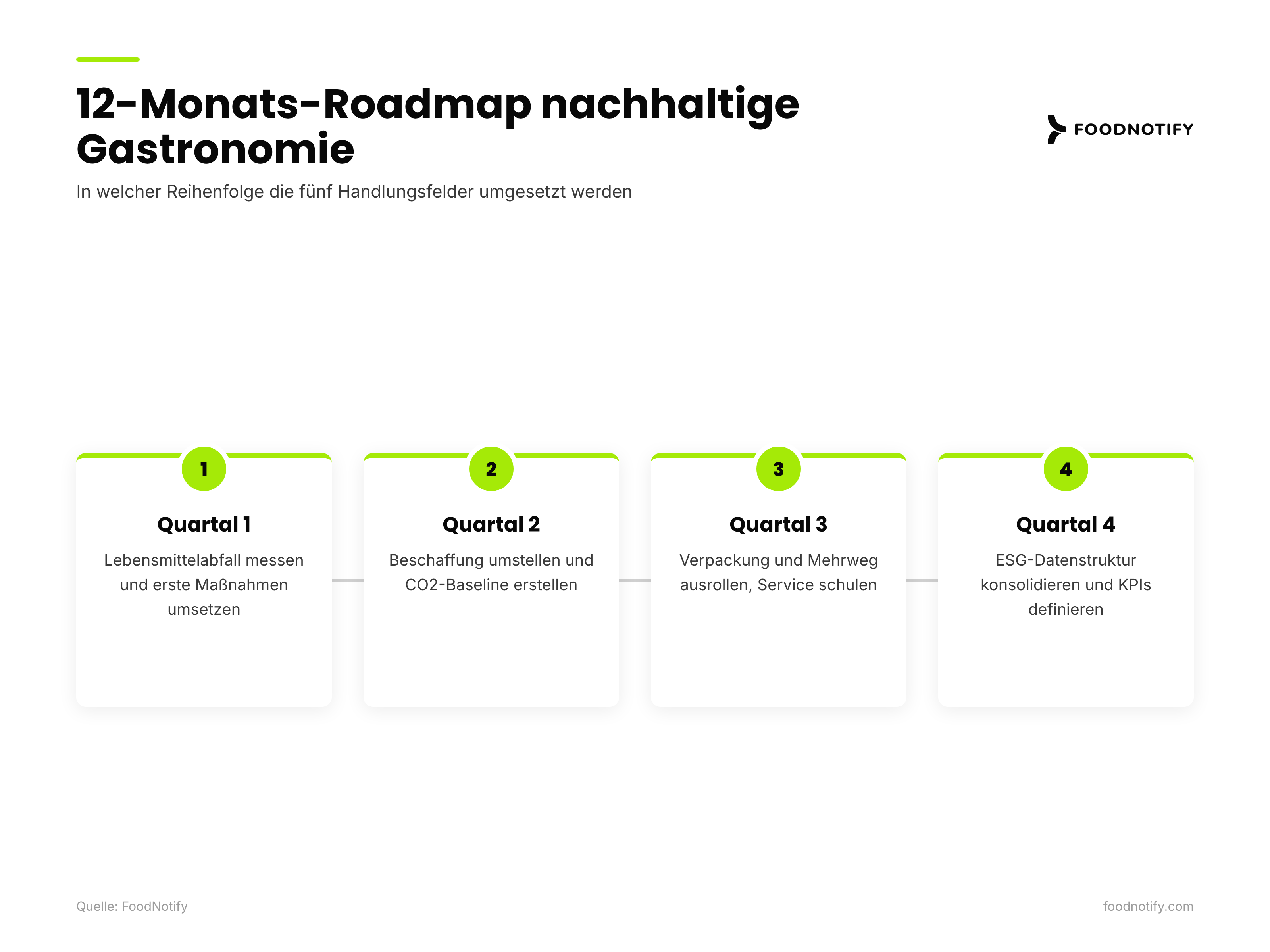
A sustainability strategy is only as good as its sequencing. If you tackle all the action areas at once, you'll overwhelm your team and lose the thread by the third quarter. The following 12-month sequence has proven itself in practice because it combines quick wins with building up the data foundation.
What happens after the 12 months? You're not done, but from then on you're steering based on data instead of gut feeling. The five action areas become a quarterly rhythm, in which you deepen and optimize one area per quarter. That's the routine that separates sustainable hospitality from sustainability marketing.
It's also important what you deliberately don't do. Don't try to set up a perfect ESG dashboard in Q1. Don't try to switch all your suppliers at once in Q2. Don't try to launch reusables in Q3 without first checking your dishwasher capacity. A sustainability strategy rarely fails because of ambition, almost always because of the sequence.
An honest truth to close on: most sustainability projects don't fail because of the idea, but because of the data structure. If you're collecting in Excel what comes from three different systems, you'll give up after six months. Tools aren't an end in themselves, but they are the precondition for your strategy not gathering dust in a desk drawer.
What data sources do you specifically need? The following overview shows the minimum required to set up reliable sustainability management.
| Data Source | What You Need It For | Who Provides the Data |
|---|---|---|
| Inventory management with recipe module | Food cost, recipes, suppliers per ingredient | F&B platform |
| Point-of-sale system (POS) | Sales data per dish and day | POS with API integration |
| Energy management | Electricity, gas, heat by consumption point | Smart meters, energy controllers |
| Reusable packaging system | Deposit transactions, reusable packaging rate | Reusable packaging provider's API |
| CO2 database | Emission factors per food item | KlimaTeller, Eaternity, your own figures |
The interesting question is how you connect these sources. An inventory management system with an open recipe module is the data backbone here. It knows every dish, every ingredient, and every supplier. If you choose a platform that communicates via API with your POS, your reusable packaging provider, and your accounting, you no longer have to piece together sustainability metrics after the fact.
In our experience at FoodNotify, businesses with an integrated data foundation produce quarterly reports in hours rather than days. The reason isn't magic tooling, but the fact that food cost, supplier structure, and recipe data are already part of daily management anyway. ESG data falls out as a byproduct once operational management is set up cleanly.
What should you look out for when choosing a tool? Three criteria are decisive:
If you're thinking about a holistic tech stack, you'll find a detailed architectural view in our article How Hospitality Businesses Build Their Tech Stack of the Future. In it, sustainability isn't a standalone topic, but a layer on top of an integrated data foundation.
Food waste includes all food originally produced for human consumption that isn't used in your operation. This includes prep losses (peeling, trimming), overproduction in the mise en place, plate waste returned by guests, and buffet leftovers. Losses in the supply chain upstream of your business don't count toward your share. The national reporting obligation follows this definition.
Only companies with more than 1,000 employees and more than €450 million in annual revenue are directly subject to reporting requirements, that is, a small number of large chains. Most restaurant businesses aren't directly obligated, but are indirectly asked to supply data via banks, major clients, or chain partners. You should therefore build a clean data foundation regardless of the formal obligation, because market-side requirements are moving faster than regulation.
Economically, your own reusable pool typically pays off from around 200 take-away orders per week, because that's when washing throughput, storage needs, and administrative overhead start to spread out. Below that volume, third-party providers like Recup or Vytal are the more economical choice. You're only exempt as a micro-business with under 80 m² of retail space and a maximum of five employees. Even then, however, you still have to fill containers guests bring with them.
A simple starting point is the KlimaTeller database, which provides emission factors for around 500 foods. You assign a CO2 value to each dish based on its recipe and compare the values against order numbers from your POS system. For energy and procurement, a simple quarterly spreadsheet is enough as a first baseline. External consulting only becomes worthwhile once you need to produce a formal report for banks or major clients.
Regional sourcing is only one part of the picture. The CO2 effect of transport distance is usually smaller than the effect of product choice, beef versus lentils, for example. A credible sustainability strategy therefore combines regionality (resilience, freshness, story), seasonality (the energy intensity of production), and product choice (the share of plant-based dishes). Three levers instead of one.
Violations carry fines of up to €10,000 per case. You also risk reputational damage, since consumer protection organizations actively list and check businesses that don't offer reusables. The obligation is clearly worded: staying silent about reusables at the register isn't enough. You must actively offer them, at the same price as single-use, visibly at the counter and on the menu.
Genuinely sustainable hospitality is no longer a marketing discipline in 2026. It's a question of operational substance. Anyone who measures food waste, documents procurement, knows their CO2 baseline, handles reusables cleanly, and keeps ESG data centralized won't be caught off guard over the next 24 months: not by banks, not by major clients, not by authorities, not by guests.
The lever with the fastest ROI remains food waste. The one with the greatest regulatory risk is packaging and reusables. The one with the greatest strategic effort is the carbon footprint. And the one that holds it all together is an integrated data foundation, where food cost, recipes, suppliers, and sales data live in one place. The sequence isn't arbitrary, it's the foundation that keeps your sustainability strategy from ending up in a desk drawer after 18 months.
If you want to know what this data foundation could look like in your business specifically: schedule a free initial consultation and see live how FoodNotify digitizes your inventory management, your food cost, and your sustainability data in a single platform.
Recipe management without manual overhead: how digital systems automatically derive allergens, nutritional values and CO2 data from supplier data —...
One percentage point of food cost equals one per cent of revenue. Formula, worked examples for 1 to 20 sites, where the figures come from and four...
Restaurant ERP ROI: TCO, cost of inaction, and two worked examples for a €1.2M single-site operator and a 5-location chain. A practical guide.