AI in Restaurants 2026: 7 Use Cases That Deliver ROI
34:30
Thursday, 7:15 p.m. In the middle of service, your head chef is staring at two truths at once: three tables are waiting on the burrata special, and there’s enough left for two portions. One floor up, your area manager scans the weekly report and notices that one of your locations has been buying tomatoes at wildly different prices for weeks, and nobody caught it.
These two scenes have more in common than it looks. Neither is a staff mistake. Both are data problems. And both are dramatically easier to solve with the right use of AI in restaurants today than they were two years ago.
What has made this conversation hard so far: AI sounds like the future, feels like hype, and US sources love to sell it with promises that don’t hold up in European hospitality. Different supplier structures, stricter data protection rules, German and Austrian working-time laws. If you invest in AI in 2026, you need a translation into your own operating reality, not a deck of generic slides.
That’s exactly what we deliver here. You’ll get seven proven use cases, what they’re worth in euros, which GDPR and bookkeeping requirements you need to demand from your vendor, and what a realistic four-to-eight-month roadmap looks like for single-site operators, small chains, and large hospitality groups.
Key takeaways
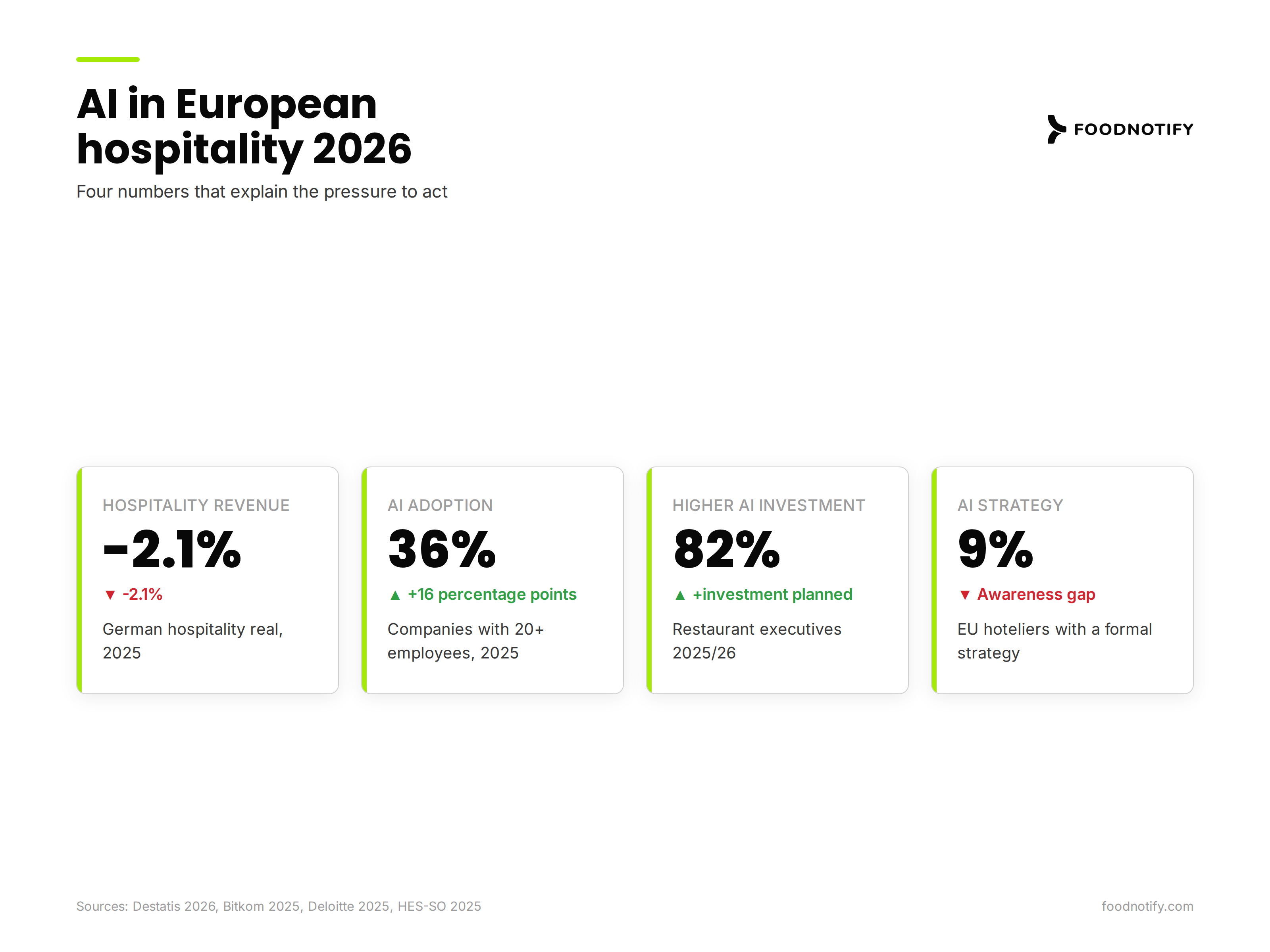
German hospitality revenue dropped 2.1% in real terms in 2025; food-led restaurants lost 2.2% Destatis, 2026. Operating without efficiency levers in 2026 means losing margin to digitized competitors.
36% of German companies with 20+ employees used AI in 2025, up from 20% the year before Bitkom, 2025. Hospitality is catching up fast.
82% of restaurant executives plan higher AI investment in 2025/2026, and 55% already use AI daily in inventory operations Deloitte, 2025.
Since February 2, 2025, Article 4 of the EU AI Act requires every company using AI to ensure documented AI literacy among its staff EU AI Act Article 4, 2025.
High-risk AI systems under Annex III, including staff scheduling, must meet all compliance obligations from August 2, 2026; violations cost up to €15 million or 3% of global annual revenue security today, 2026.
Why is 2026 the year of AI in restaurants?
Three forces are converging on European hospitality in 2026, and they all pull in the same direction.
First: margin pressure. Hospitality revenue dropped 2.1% in real terms in 2025, with food-led restaurants down 2.2% Destatis, 2026. Raise prices into rising labor, energy, and food costs and you lose guests. Hold them flat and you lose margin. Efficiency is no longer a strategic option, it’s the precondition for talking about growth in 2027.
Second: the technology is ready. AI models that were pilot toys two years ago now run reliably inside standard inventory management systems. Bitkom measured a jump from 20% to 36% AI adoption among German companies with 20+ employees in a single year Bitkom, 2025. If you start now, you’re not early, you’re on schedule.
Third: the industry is following through. Deloitte surveyed 375 restaurant executives across 11 countries. A clear majority plan higher AI investment in 2025/2026, and a significant share already use AI daily in inventory and guest communication Deloitte, 2025. AI is becoming a hygiene factor: skip it and you look behind, especially against chain competitors.
What does this mean for you in concrete terms? Three things. You pick use cases that work in the European market, not the US market. You build in the regulatory obligations of the EU AI Act from day one, otherwise your efficiency gains turn into fine risks. You plan a roadmap that fits your operation size. That’s exactly what the next sections cover.
One more framing point: AI doesn’t replace people in hospitality, it relieves them. DEHOGA North Rhine-Westphalia puts this plainly in its industry position. AI should handle routine work so that your scarce skilled staff can serve guests and protect quality DEHOGA NRW, 2025. That frame matches the reality of European hospitality, where skilled labor is the scarcest resource and human-in-the-loop is non-negotiable.
7 proven AI use cases for hospitality operators at a glance
Before we go deep on the three most important ones, here’s the full picture. Each use case carries a short maturity label: production-ready means you can find it in standard software stacks today, in pilot means early European operators are running it live, early means real-world practice is just starting.
DEHOGA North Rhine-Westphalia groups the industry’s AI applications into four fields: routine relief, procurement and inventory optimization, forecasting, and content creation DEHOGA NRW, 2025. In day-to-day practice, those four fields translate into seven concrete use cases that we work with across the FoodNotify network:
AI demand forecasting (production-ready). A forecast built from sales history, weather, school holidays, and event calendars. In an illustrative scenario from the FoodNotify network, this lowers food cost by two to four percentage points and reduces out-of-stock situations during service.
Automated inventory with the FoodNotify inventory app (production-ready). Your team captures stock directly on a smartphone or tablet. The app reconciles quantities with recipes and delivery data and hands them off to your inventory system. In an anonymized observation from the FoodNotify network, one multi-site customer cut inventory time per site from over two hours to under one, measured across multiple counting cycles before and after introducing the app Data from the FoodNotify network.
Dynamic order recommendations with VAT logic (production-ready). AI generates order proposals for your connected wholesale partners, including VAT differentiation (7% vs. 19% in Germany, 10% vs. 20% in Austria) and best-price supplier selection per item § 12 UStG, 2026.
AI staff scheduling (in pilot). Forecast-based shift plans, embedded in the hard guardrails of the German Working Time Act and the Austrian Working Time Act. The model recommends, your manager approves.
Menu engineering with AI (production-ready). The model rates every dish by contribution margin, sales frequency, and price sensitivity, then suggests cuts, repositioning, or price adjustments.
Allergen chatbot for guests (production-ready). On your website or via a QR code at the table, a chatbot answers EU food information regulation questions straight from your current recipe database. It measurably relieves your service team during peak hours.
Predictive maintenance for kitchen equipment (early). Sensors on walk-in coolers, combi steamers, and dishwashers flag anomalies before they become breakdowns. Still early-stage in practice, but economically relevant from the third site onward.
What ties these seven together is the data foundation. Without clean master data, a connected POS, and properly maintained recipes, every model stays a toy. Investing in AI in 2026 means investing just as much in the data base underneath. That’s the uncomfortable truth behind the hype.
A second observation: success depends much more on use case selection than on vendor. A well-matched pilot of use case one beats an ambitious pilot of use case seven at almost every operation size. Let’s look at what that means in practice, starting with the use case that delivers the clearest ROI.
How does AI demand forecasting actually lower your food cost?
In the European market, AI demand forecasting is the use case with the cleanest euro effect. It combines three data streams: your sales history from the POS, external signals like weather, school holidays, local events, and public holidays, and your recipes with the linked ingredients. The result is a daily and weekly forecast per dish, and therefore per ingredient.
Here’s what that means in euros, anchored on a typical European single-site operation.
Illustrative scenario: a modern bistro in a mid-sized German city with €1.2 million in annual revenue and a 30% food cost ratio, meaning €360,000 in food cost per year. Based on observations from the FoodNotify network, a food cost reduction through AI demand forecasting sits in the low single-digit percentage range of food cost. At two to four percentage points, this model puts the saving at €7,200 to €14,400 per year, before adding the effects of saved labor time and food waste reduction FoodNotify practice. This is an illustrative scenario, not a guarantee for every business.
If you run a multi-site operation with 5 to 25 locations, the effect doesn’t scale linearly, it scales more than that. A central data base improves forecast quality because the model learns from more points of sale. You’ll know the phenomenon: weather at site four feeds the forecast at site one.
For the effect to actually land, your supplier integration has to be clean. The European foodservice wholesale landscape is dominated by a handful of heavyweights that typically offer EDI or API interfaces, though the maturity varies. When you evaluate vendors, check that your preferred suppliers are available as standard connectors in the AI solution. Custom mappings regularly cost two to three times what standard onboarding costs.
What your AI absolutely has to model: VAT differentiation between 7% (takeaway food, groceries) and 19% (dine-in, drinks) in Germany, and 10% (food) and 20% (drinks, alcohol) in Austria. A model that only does gross calculations produces worthless recommendations in European practice. Your margin differs by VAT rate, and promotions often target exactly this line.
What many vendors quietly skip over: the seasonal curve. A model that only sees the last twelve weeks will recommend May asparagus quantities based on April, instead of based on last May. Ask your vendor directly how far back the training data reaches and how seasonal special effects (asparagus season, game season, the Advent weekends) are modeled. Adoption data underlines how central this use case is becoming: 55% of restaurant executives surveyed already use AI daily in inventory operations Deloitte, 2025.
The full math for our bistro looks like this: food cost reduction of €7,200 to €14,400, additional food waste reduction of €4,000 to €8,000, and roughly 90 hours per year saved for kitchen leadership on ordering (about two hours per week across 45 ordering weeks, observed in the FoodNotify network). You can monetize those hours, because the fully loaded cost of qualified kitchen leadership in Germany sits well above minimum wage when you include all employer contributions. We go deeper on this lever in our article on reducing food cost in your restaurant.
What to do in practice: define a clear KPI baseline before the pilot starts. Food cost ratio per week, out-of-stock incidents per service, food waste kilos per week. Start without a baseline and you can’t prove the effect at the end, which means you can’t take it to the management team.
What GDPR and bookkeeping requirements does AI need to meet in your operation?
If you use AI in a restaurant, you’re operating in three regulatory worlds at once: GDPR for data protection, GoBD for orderly bookkeeping in Germany, and since early 2025 the EU AI Act on top. The three interlock, and you can only stand behind a solution that addresses all three.
Start with GDPR. As soon as your AI vendor processes personal data (staff shift plans, applicant data, guest reservations), you need a data processing agreement with the vendor. EU hosting isn’t legally required, but it’s the practical recommendation. With servers in the EU, you skip the debate over third-country transfers and Schrems II safeguards. Gastgewerbe-Magazin makes the same point plainly in its expert article: local data processing is the most pragmatic compliance path for hospitality Gastgewerbe-Magazin, 2026.
The second layer: GoBD bookkeeping requirements. Every order recommendation, every automatic posting in inventory, and every AI-driven price suggestion has to be audit-proof. That means immutable records, complete logging with timestamps, and procedural documentation for the AI model in use. If your tax audit asks in three years why you ordered twelve cases of mozzarella at a special price on November 15, 2026, your AI solution has to answer.
The third layer, new since 2025: the EU AI Act. Article 4 has required every company using AI to ensure documented AI literacy among its staff since February 2, 2025 EU AI Act Article 4, 2025. In practice: you have to train your kitchen leadership, your service team, and your accounting staff on how the deployed AI tools work, what their limits are, and how AI recommendations get approved. And you have to document that training.
Article 5 of the EU AI Act bans certain practices outright as of the same date, with fines up to €35 million or 7% of global annual revenue EU AI Act Article 5, 2025. What’s particularly relevant for hospitality: the ban on emotion recognition in the workplace (no mood-scoring of service staff) and the ban on biometric categorization of sensitive characteristics. It sounds like science fiction, but it has shown up in individual US vendor demos.
What does that mean for your vendor selection? Five concrete requirements:
A data processing agreement ready to sign on the table
Server location in the EU
GoBD-compliant logging in the standard product
Built-in AI literacy training with proof mechanics, ideally inside the tool
Documented refusal to engage in Article 5 prohibited practices
Modern inventory management systems like FoodNotify cover this compliance layer in the standard product, because we’re built natively for the European market. With US vendors, you have to raise these points explicitly and write them into the contract. If you negotiate the data processing agreement after signing, you’ve already lost leverage.
AI staff scheduling within German and Austrian working-time laws
AI staff scheduling is the hottest use case in European chain hospitality, and the trickiest. Hot, because labor cost is the dominant cost line in many operations in 2026. Tricky, because the regulatory guardrails are narrow and a poorly configured model lands you in fine territory fast.
The core idea: your model calculates a staffing demand in service and kitchen hours per day and per shift, based on historical occupancy data, weather, events, and reservation status. From that, it produces a shift plan proposal that accounts for permanent staff, casual workers, and flexible contracts. Sounds like a shift planner with AI on top, and at its core that’s exactly what it is. The question isn’t whether the model can do math. The question is whether it knows your legal situation.
In Germany, the Working Time Act (ArbZG) applies: a maximum of eight hours per working day, exceptionally ten with compensation within six months § 3 ArbZG. An eleven-hour rest period between shifts § 5 ArbZG. Sunday and public holiday rest with the standard hospitality exemptions. In Austria, the Working Time Act (AZG) and Rest Periods Act (ARG) apply with similar cornerstones, though with partly different rest period rules and the relatively recent 12-hour daily maximum WKO on the AZG amendment, 2018. For employees under 18, separate rules apply, and your model has to know them.
What does that mean for the AI configuration? Six parameters have to be hard-coded before the first run:
These six parameters aren’t recommendations, they’re hard constraints. An AI-generated shift plan that violates any of them must not pass approval in your operation. Better still, the model shouldn’t even produce such proposals, it should filter them out at the generation step.
Another point matters: AI staff scheduling falls under Annex III of the EU AI Act, the high-risk category. High-risk AI systems must meet all compliance obligations from August 2, 2026 security today, 2026. That includes a risk management system, documented data quality, post-market monitoring, and human oversight. In concrete terms: you can use AI for scheduling, but every plan proposal has to be approved by a qualified human.
DEHOGA North Rhine-Westphalia lists automatic scheduling among digital assistance applications in its industry position DEHOGA NRW, 2025. The need for qualified staff approval also follows directly from the high-risk classification under the EU AI Act. Human-in-the-loop isn’t a nice-to-have here, it’s a compliance obligation. What to clarify before you sign: how are ArbZG and AZG encoded in the model, who’s liable when the law changes, and what does the approval workflow look like technically? If you don’t get clear answers, don’t sign. The broader frame on this cost block sits in our article on managing restaurant labor cost.
AI maturity: single-site, multi-site, and chain operators compared
Which AI is realistically usable depends less on the vendor and more on your operation size and data maturity. Three stages are clearly distinguishable, and they differ not just in scale but in the qualitative requirements.
Before we get to the table, one note from aggregated data in the FoodNotify network: data maturity doesn’t grow on its own with the number of sites. A 15-site operator whose POS data lives in five different versions has a worse data base than a single site with a clean POS and connected inventory. Do the maturity check before the AI investment, not after.
All 7 use cases, focus on demand, ordering, staffing, menu
Mid five-figure per year
4 to 8 months
Chain (50+)
Cluster-specific ML models per site type
Six-figure per year
6 to 12 months
Stage one, the single-site operator, enters differently than a multi-site operator. Realistic use cases are OCR invoice capture, a simple demand forecast based on POS data plus weather, and an allergen chatbot on your website. More complex models like AI staff scheduling or predictive maintenance usually only pay off when you’re thinking about growth.
Stage two, the multi-site operator, needs a central data base, otherwise the models can’t learn from each other. The logic flips here from individual case to network. ROI gets particularly attractive at this stage because scale effects kick in.
Stage three, the chain operator, isn’t talking about standard use cases anymore. The conversation is about cluster-specific ML models. Site cluster A (city center, office lunch) needs different forecast parameters from cluster B (suburban location, family weekend). Usually there’s a dedicated data science team at headquarters.
This differentiation explains why a multi-country survey by Prof. Roland Schegg (HES-SO Valais-Wallis) of European hotels across Germany, Austria, Switzerland, France, Italy, and Greece measures a paradox: 72% of hoteliers consider AI (very) important, but only 9% have a formalized AI strategy, and 35% test tools without any strategic frame HES-SO Valais-Wallis, 2025. The awareness-to-action gap isn’t a tool problem, it’s a strategy problem at the wrong maturity level.
Good rule of thumb: if you can’t consistently report your food cost ratio per week and per site, AI isn’t your next step, clean inventory management is. AI on chaotic data produces plausibly wrong recommendations, and that’s more dangerous than no model at all. For a deeper look at building the foundation, our article on the restaurant tech stack of the future lays out the full frame.
What does a realistic AI roadmap over 4 to 8 months look like?
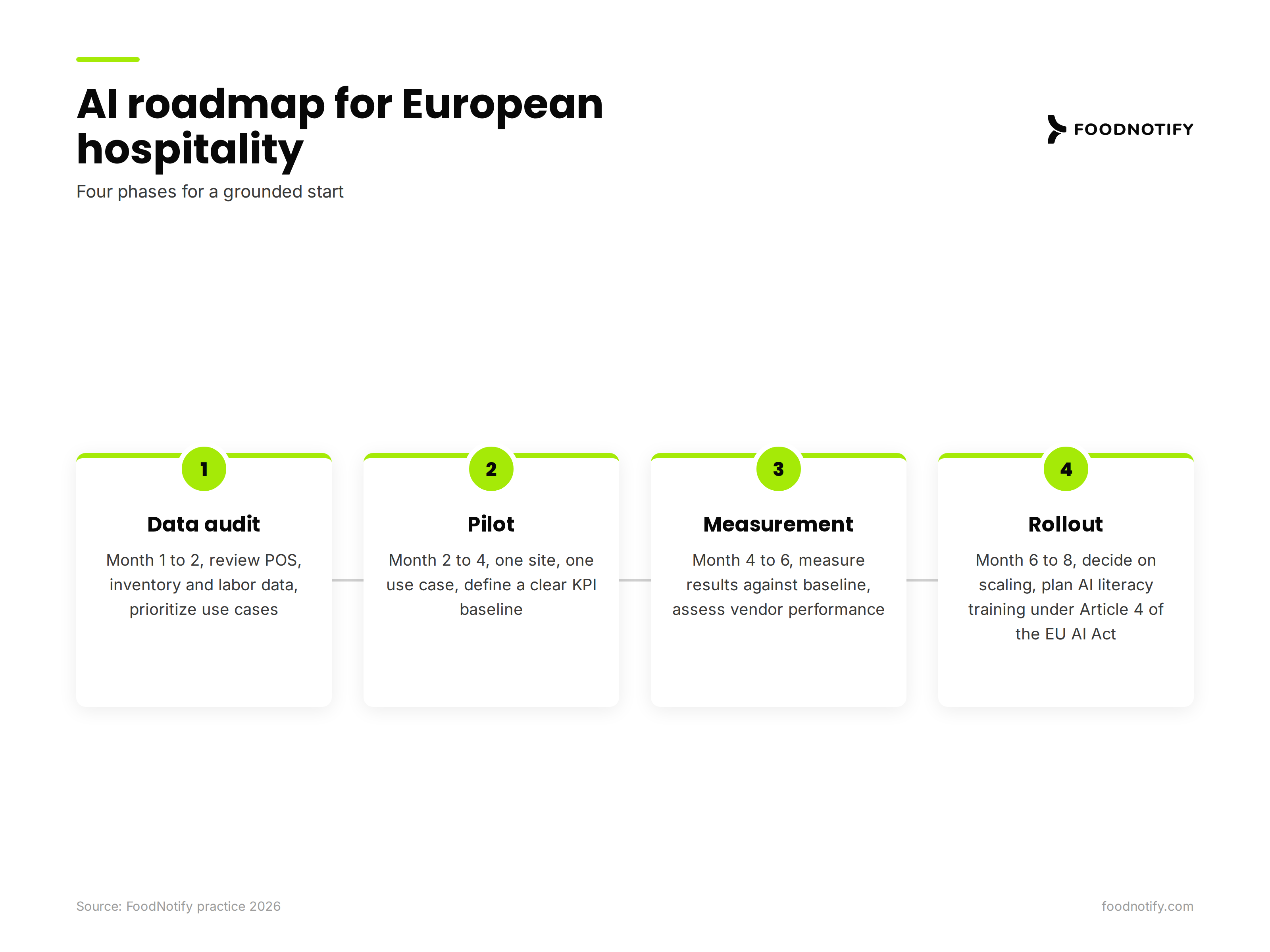
A pragmatic AI roadmap has four phases. Most European operators need four to eight months to reach a grounded rollout decision. Some chains need longer; single-site operators get there faster.
Phase 1: Data audit and use case prioritization (months 1 to 2).
You check three things: which data streams do you have structured today (POS, inventory, labor)? Which use cases offer the biggest ROI for your operation? Which regulatory requirements hit you first? Output: a prioritized list with a maximum of two use cases for the pilot. Start with five use cases and you’ll fail at complexity.
Phase 2: Pilot with one site and one use case (months 2 to 4).
This phase is about speed, not perfection. Pick a site that’s representative (not your best, not your worst), pick one use case (usually demand forecasting or inventory), and define a hard KPI baseline: food cost ratio in the previous period, food waste volume, out-of-stock incidents. Skip the baseline and three months later you can’t prove the effect.
Phase 3: Measurement against the KPI baseline (months 4 to 6).
Eight to twelve weeks of live operation, then evaluation with hard numbers. Three questions: did the baseline KPI improve significantly? Was the change attributable to the AI tool, or to a parallel measure (a staff change, a seasonal effect)? How did the vendor perform on updates, training, and support?
Phase 4: Rollout decision and scaling (months 6 to 8).
Based on measured pilot data, you decide on rollout, re-pilot, or stop. If you scale, plan the AI literacy training under Article 4 of the EU AI Act EU AI Act Article 4, 2025 and document the training concept. For high-risk use cases (staff scheduling), the August 2, 2026 deadline goes into the plan.
Three typical stumbling blocks in this roadmap. First: too many use cases at once. Two is the absolute maximum, one is the norm. Second: missing KPI baseline. Without a before-measurement, you have nothing to take to the management team. Third: training at the end. If training only starts at rollout, you risk compliance gaps and unhappy teams.
Investment range for the pilot, as an experience value from implementation projects in the FoodNotify network: single-site €3,000 to €8,000, a five-site operator €15,000 to €35,000, chain operators six-figure. These ranges describe an illustrative scenario and don’t replace a concrete quote.
What we see across the FoodNotify network: operators that start with a clear pilot setup and a hard baseline come out of the eight-month roadmap with a grounded decision. Operators who pick “let’s just try something” as a strategy are usually just as smart twelve months later as when they started, only poorer.
Frequently asked questions
What does AI in a restaurant actually deliver in euros?
In a typical European single-site operation with €1.2 million in annual revenue and a 30% food cost ratio, AI-driven demand forecasting cuts food cost by two to four percentage points in our illustrative scenario. That works out to €7,200 to €14,400 per year, before you factor in saved staff time and food waste reduction. Multi-site operators usually achieve similar or slightly higher per-site values because central data improves forecast quality.
What GDPR and bookkeeping obligations apply to AI tools in your restaurant?
You need a data processing agreement with your AI vendor, EU-based hosting of personal data as a practical recommendation, GoBD-compliant logging of every automated booking recommendation, immutability of records, and procedural documentation. On top of that, since February 2, 2025, Article 4 of the EU AI Act requires you to train your staff in AI literacy and to document it.
When does the EU AI Act take effect for AI-driven staff scheduling?
AI staff scheduling tools fall under Annex III of the EU AI Act and count as high-risk AI systems. From August 2, 2026, they must meet all compliance obligations: a risk management system, documented data quality, human oversight, and post-market monitoring. Violations cost up to €15 million or 3% of global annual revenue.
How long does a realistic AI pilot take in European hospitality?
Four to eight months is a realistic timeframe for a single-site operator or a small multi-site operator. Month 1 to 2 covers the data audit and use case selection, month 2 to 4 the pilot at one site, month 4 to 6 the measurement against your KPI baseline, and month 6 to 8 the rollout decision. Chain operators with 50+ sites need six to twelve months.
Which AI use cases work for single-site operators with a limited data base?
Three use cases work well for single-site operators: automated invoice capture via OCR, a simple demand forecast suggestion from POS data plus weather, and an allergen chatbot for your guests. More complex models like AI staff scheduling or cluster-specific forecasts usually only pay off from the third location onward.
What hospitality operators should do now for their AI start
AI in restaurants is no longer a question of if in 2026, only of how and when. If you take margin pressure seriously, you can’t avoid efficiency investment. If you take the EU AI Act seriously, you plan today for the August 2, 2026 deadline on high-risk use cases. If you take the pace of the industry seriously, you see that 55% of restaurant executives already use AI daily in inventory operations Deloitte, 2025.
Three steps separate a successful AI start from expensive learning. First: you pick a maximum of two use cases that fit your operation size. Single-site operators start with OCR and a simple forecast, multi-site operators with demand forecasting and dynamic ordering, chain operators with cluster-specific models. Second: you define a hard KPI baseline before the pilot starts. Third: you clarify GDPR, GoBD, and the EU AI Act with your vendor before you sign.
Want to see how FoodNotify can simplify your hospitality operations? Get in touch and our team will show you live how we digitize your inventory management and which AI use cases will deliver the biggest impact in your operation.
Centralized inventory management for restaurant chains: 5 building blocks, must-have integrations, reporting setup and a rollout plan from pilot to...
Thomas Primus
Jun 16, 2026
Stay up to date
Make sure you never miss out on updates and trends about digitalization in the hospitality industry by subscribing to our monthly newsletter. You will receive useful information delivered directly to your inbox.